
Transformation Office
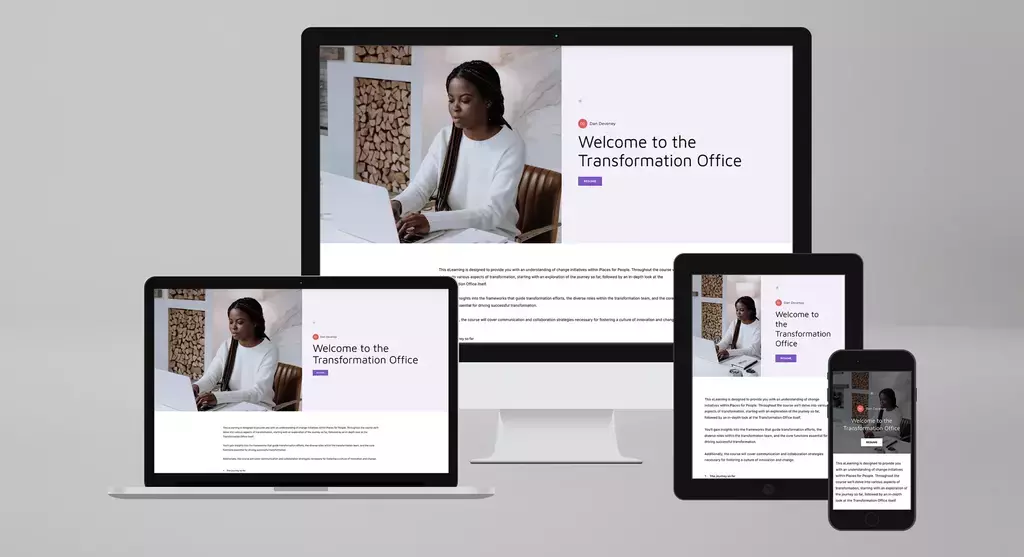
This project involved the design and development of a comprehensive eLearning program tailored specifically for new team members joining the Transformation Office at Places for People. The program's primary goal is to provide new starters with the essential foundational knowledge and practical skills necessary to successfully integrate into the team, understand the organisational change landscape, and contribute effectively to ongoing project delivery within a dynamic environment. The program is designed as a blended learning experience, combining self-paced online modules with opportunities for practical application and collaborative learning. This ongoing initiative aims to establish a robust and scalable onboarding process for the Transformation Office.
Places for People
2024
Blended
End-to-End Designer
Problem
The rapid growth and evolving nature of the Transformation Office at Places for People necessitated a standardised, efficient, and effective method for onboarding new team members. Previously, onboarding was potentially inconsistent, relying heavily on ad-hoc processes and individual mentoring.
Tools Used
- Articulate Storyline/Rise 360: eLearning authoring
- MS DevOps: Content related to usage within the program
- Learning Pool/Totara: Program delivery and tracking
- Microsoft Teams: Communication and potential collaborative activities
- Canva: Video creation for modules
Solution
I designed and developed a blended eLearning program leveraging adult learning principles and modern learning technologies. The solution includes:
- Structured Curriculum: Developed a curriculum covering key areas such as change management principles, Places for People's organisational context, project management methodologies (including an introduction to MS DevOps), and practical application scenarios.
- Self-Paced eLearning Modules: Created engaging and interactive online modules using Articulate Storyline/Rise 360. Content was broken down into microlearning units to enhance knowledge retention and engagement. Gamification elements were integrated to motivate learners and reinforce key concepts.
- Practical Application & Collaboration: Incorporated case studies, simulations, and opportunities for practical application, including guidance on shadowing experienced team members. The program encourages collaboration through online forums and potentially group activities to foster a sense of community and peer learning.
- Tool Proficiency: Included specific modules and exercises focused on familiarising new starters with essential tools like MS DevOps, enabling them to quickly navigate and utilise these platforms effectively.
- LMS/LXP Integration: Integrated the eLearning content with the existing Moodle LMS/LXP to track learner progress, manage assignments, and facilitate reporting on program completion and performance.
- Feedback Mechanisms: Built in mechanisms for collecting feedback from learners to facilitate continuous improvement of the program content and delivery.
This blended approach ensures flexibility for learners while providing essential structure and opportunities for applied learning and interaction.
Impact
- Improved Onboarding Efficiency: Provides a consistent and scalable onboarding experience, reducing the time required for new starters to become productive team members.
- Enhanced Foundational Knowledge: Equips all new starters with a solid understanding of change management, organisational context, and key tools from day one.
- Increased Confidence and Preparedness: New team members feel more prepared and confident in their roles, leading to quicker integration into project teams.
- Consistency in Skills: Ensures a baseline level of knowledge and familiarity with essential tools and processes across the Transformation Office team.
- Data-Driven Improvement: The integration with the LMS/LXP allows for tracking and analysis of learner data, enabling continuous refinement and optimisation of the training program based on actual usage and performance. (Note: As the program is ongoing, quantitative impact data is still being collected, but qualitative feedback indicates positive early results).
Lessons Learned
- Criticality of Stakeholder Engagement: Early and continuous involvement of stakeholders from the Transformation Office was paramount. Their insights into specific needs, cultural nuances, and tool usage were essential in ensuring the program's relevance and alignment with operational requirements. This reinforced that successful learning solutions are deeply rooted in the context and challenges of the target audience and business unit.
- Value of Iterative Development: The decision to adopt an iterative development approach, including pilot testing with a small group of early learners, proved invaluable. Feedback gathered during piloting allowed for significant adjustments and refinements to content, activities, and pacing before the full rollout, preventing potential issues at scale.
- Designing for Engagement in eLearning: Creating truly engaging and interactive eLearning content requires deliberate planning beyond simply digitising existing materials. Utilising a variety of media types (videos, simulations, interactive exercises) and incorporating elements like gamification and real-world scenarios is crucial for maintaining learner attention and promoting knowledge application, especially in a self-paced environment. Attention to detail in UI/UX within the authoring tools significantly impacts the learner experience.
- Importance of LMS/LXP Integration Planning: Seamless integration with the existing Moodle LMS/LXP required careful planning regarding content packaging (SCORM/xAPI), tracking requirements, and user access. Ensuring robust tracking was vital for future impact measurement and program iteration.
